In 1939, a Mesa gas station owner named Ted Sliger dug a well in his backyard, hoping for fresh drinking water. Instead, he struck 113-degree mineral water bubbling up from 300 feet underground and accidentally set in motion the chain of events that would turn Arizona into a spring training empire worth three-quarters of a billion dollars.
It’s one of the most improbable origin stories in all of professional sports.
Bill Veeck Brings Baseball West
The Cactus League’s roots trace back to 1946, when Cleveland Indians owner Bill Veeck moved his team’s spring training to Arizona for two reasons: it was closer to his Tucson ranch, and after signing Larry Doby as the American League’s first Black player, he refused to subject him to the cruelties of the Jim Crow South. But Veeck had a problem: his Indians had nobody to play against.
The Birth of the Buckhorn Baths Legacy
Enter the Buckhorn Baths. Sliger’s accidental hot spring discovery had blossomed into a full-blown motel and spa on East Main Street in Mesa, complete with a towering neon sign visible for miles across the flat desert. Word of the property’s supposed healing mineral waters reached New York Giants owner Horace Stoneham, who had already been fielding pitches from Veeck and local boosters eager to bring more teams west.
After experiencing the Buckhorn’s therapeutic waters firsthand, Stoneham moved the Giants’ spring training to Arizona in 1947, giving Veeck’s Indians a dance partner and planting the seed for what would become the Cactus League. The Chicago Cubs followed in 1951, drawn by the promise of what team management described as “healthful clean fun.” When the Orioles arrived in Yuma in 1954, the league was officially born.
A Desert Hub for Baseball Legends
The Buckhorn became its unlikely headquarters. Hall of Famers like Willie Mays, Ted Williams, Ernie Banks, and Joe DiMaggio all passed through its doors. The Giants even credited their stays at the spa with helping the team win the 1954 World Series. And in an era of widespread segregation, the Buckhorn was notably welcoming, as Black players like Mays stayed alongside their white teammates, with no exceptions.
The Cactus League Today
Fast forward nearly eight decades, and that scrappy desert experiment has become an economic juggernaut. The 2025 Cactus League season generated an estimated $764 million in economic impact for Arizona, according to Arizona State University’s W.P. Carey School of Business. Nearly 1.7 million fans filed through turnstiles across 221 games, visitor spending topped $378 million, and the season created more than 6,100 jobs statewide.
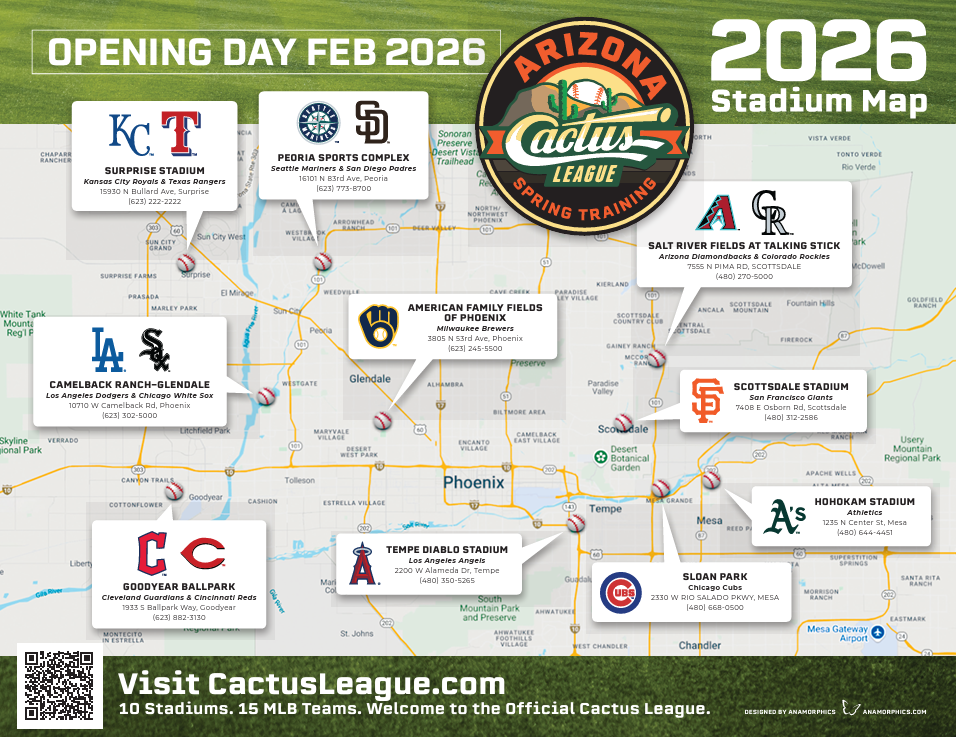
Today, 15 Major League Baseball teams call Arizona’s Valley of the Sun home each February and March, spread across 10 state-of-the-art ballparks from Scottsdale to Surprise. About six in ten attendees travel from out of state, and a third of those fans have been making the pilgrimage for five years or more, drawn back by sun-drenched afternoons, intimate ballpark settings, and the chance to see tomorrow’s stars up close.
The Spirit of Spring Training
The games may not count in the standings, but for Arizona and the fans who flock here every spring, they mean everything. Ready to plan your trip? Find full team schedules and start building your Cactus League itinerary below.
Team Schedules & Links:
- 2026 Cactus League Full Schedule
- Build a Custom Schedule
- Download the 2026 Schedule & Map (PDF)
- Stadium Map & Directions
- Trip Planner
Learn More:
- The Wild Story of How the Cactus League Came to Be – MLB.com
- About the Cactus League – CactusLeague.com
Source: cactusleague.com
Header Image Source: cactusleague.com
